
Car Recovery & Insurance Claims in Dubai: The Complete Guide
A car recovery insurance claim in Dubai succeeds or fails on documentation: a police report, 12-angle photo evidence, and the correct paperwork submitted together. Insurers do not reject well-documented claims — they delay poorly documented ones. This guide gives you the exact process our team follows on every accident recovery, so your claim moves instead of stalling.
What should I do at the scene before the recovery?
The minutes after an incident determine how smooth your claim will be. In order:
- Ensure safety first. Hazards on, and follow the breakdown safety steps — on highways, stay in the car with your seatbelt on.
- Call the police (999). For any accident, a police report is mandatory for the insurance claim. For minor accidents with no injuries, you can also report via the Dubai Police app, but get the report number either way.
- Photograph everything before anything moves. This is the step most drivers skip and later regret. Capture the overall scene, vehicle positions, road markings, and all damage — then the 12-angle set of your own car described below.
- Exchange details with other drivers: name, phone, plate number, insurance company.
- Call your licensed recovery company. Tell the operator it is an accident recovery so they bring photo-documentation equipment and coordinate timing with the police report.
How should I photograph the car for the claim?
Insurers and assessors work from photos more than from descriptions. Take this 12-angle set with your phone — it takes two minutes:
- Front, rear, left side and right side — straight-on shots
- All four corners at 45 degrees — these show panel alignment and hidden damage
- Close-ups of every damaged area, plus the number plate in at least one frame
- Interior: dashboard (warning lights, odometer reading), seats and any interior damage
- Underbody if it is safe to crouch and shoot — or ask the recovery crew to capture it on the flatbed
Take the full set before loading and again at delivery. Timestamped before-and-after photos prove the car's condition at each handover — they protect you against damage disputes with the recovery operator and give your insurer a clean evidence chain. Our crews shoot this documentation as standard on every accident recovery, and we share the images with you.
What documents does the insurer need?
Prepare this file before you visit the insurer or start the online claim. Missing items are the number one cause of delays:
| Document | Why it matters |
|---|---|
| Police report (or report number) | Mandatory for accident claims — no report, no claim |
| Emirates ID & driving licence | Proves identity and that you were licensed to drive |
| Vehicle registration card (mulkiya) | Proves ownership and that registration was valid |
| Insurance policy document | Confirms your cover type and policy period |
| Photo documentation (12-angle set) | Evidence of damage extent and pre-existing condition |
| Recovery/towing invoice | Needed to reimburse recovery costs under comprehensive policies |
Keep copies of everything you submit, and note the name of every person you speak to at the insurance company along with the date.
What is the step-by-step claim process?
- Report the incident to your insurer as soon as possible — most policies require notification within a short window. Have your policy number ready.
- Submit the full document set at once, not piecemeal. One complete submission beats three partial ones.
- Vehicle inspection. The insurer will appoint an assessor or direct you to an approved garage for inspection. Do not authorise repairs before the assessor has seen the car.
- Get the repair authorisation in writing, confirming what is covered and whether you use an agency (dealer) or non-agency garage — this affects part quality and your excess.
- Repairs and settlement. The garage repairs the car; the insurer settles with the garage directly, and you pay only your policy excess.
Throughout the process, the recovery invoice matters: if your comprehensive policy covers recovery costs, submit it with the claim file rather than afterwards.
What mistakes get claims rejected or delayed?
- No police report. The single most common reason for outright rejection of accident claims.
- Moving the car before documentation. Once the scene is cleared without photos, you cannot reconstruct the evidence.
- Authorising repairs before inspection. The insurer can refuse to pay for work it never approved.
- Using an unlicensed recovery operator. Some insurers question or reject recovery-cost reimbursement when the tow was performed illegally — another reason to check the RTA licensing rules.
- Late notification. Report promptly; policies have time limits.
Need accident recovery with claim-ready documentation?
Our Al Quoz dispatch team answers 24/7. Call now and a recovery truck will be on its way in minutes.
Documented Recoveries
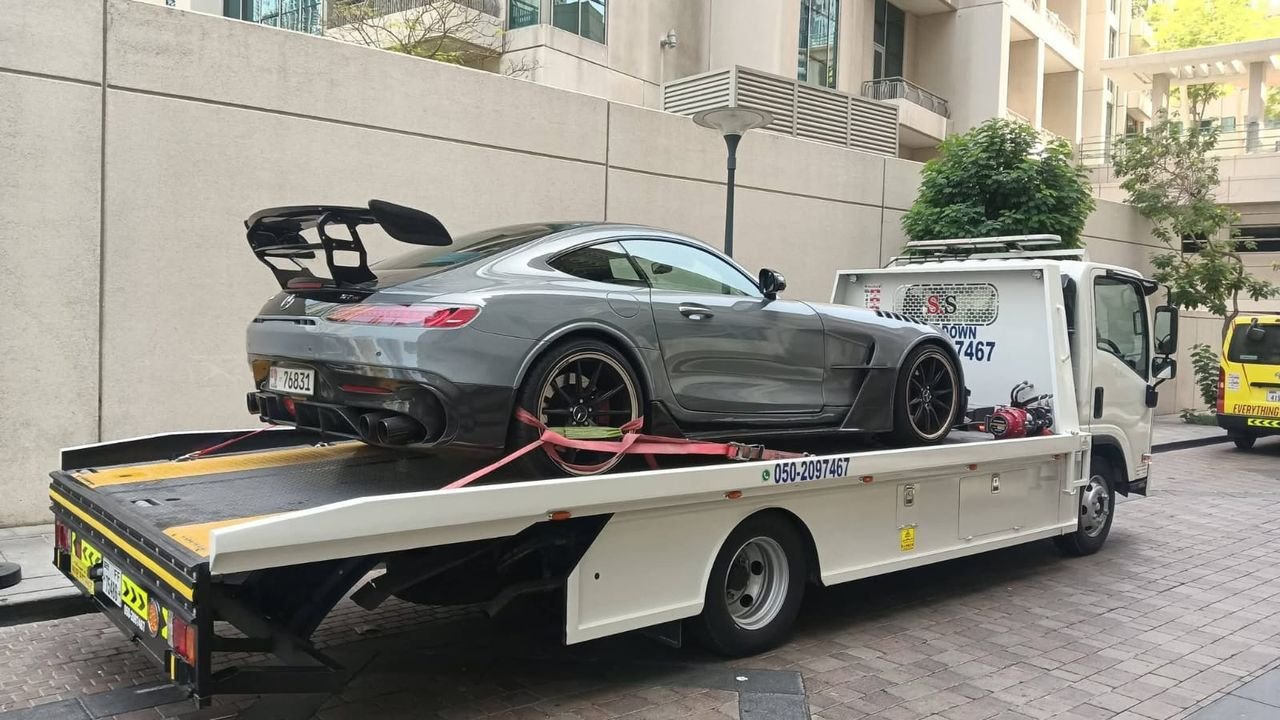
Real photos from our daily recovery work in Dubai.
Frequently Asked Questions
Do I need a police report for an insurance claim in Dubai?
Yes, for any accident-related claim. Dubai insurers require an official police report before they process vehicle damage claims — call 999 at the scene or file through the Dubai Police app for minor accidents. Without a police report, your insurer can reject the claim outright, so this is the single most important document in the process.
What documents do I need for a car recovery insurance claim?
You will need the police report, your Emirates ID, driving licence, vehicle registration card (mulkiya), insurance policy document, and photo documentation of the damage. If a recovery company moved the car, keep their invoice too — some policies reimburse recovery costs when the claim is approved. Having everything ready avoids weeks of back-and-forth.
Should I photograph my car before the tow truck loads it?
Absolutely. Take photos of all four sides, each corner, the roof, the underbody if accessible, the interior and the odometer — at least 12 angles — before the car is loaded and again at delivery. These timestamped photos prove the vehicle condition at each handover and are your strongest evidence if damage is disputed later.
Will my insurance pay for the recovery tow itself?
It depends on your policy. Comprehensive policies in the UAE often include roadside assistance or reimburse recovery costs for covered incidents, while third-party policies typically do not. Check your policy wording or call your insurer before the tow if possible — and always keep the recovery invoice, because you cannot claim a cost you cannot prove.
How long do insurance claims take in Dubai?
Simple claims with complete documentation can settle in one to three weeks; complex or disputed claims take longer. The biggest cause of delay is incomplete paperwork — missing police reports or poor photo evidence. Submitting everything at once, including recovery documentation, is the fastest way to move your file forward.