
Flatbed vs Wheel-Lift Towing: Which Is Right for Your Car?
The two main towing methods are flatbed towing — your whole car rides on a level platform — and wheel-lift towing — two wheels are raised while two roll on the road. Flatbed is the safest method for almost every car and the only safe method for luxury, sports, AWD and 4x4 vehicles. This guide compares both so you can insist on the right one when you call.
How do flatbed and wheel-lift towing compare?
| Flatbed towing | Wheel-lift towing | |
|---|---|---|
| How it works | Car winched or driven fully onto a level truck bed; all four wheels off the road | Hydraulic lift raises two wheels; the other two roll on the ground |
| Drivetrain safety | Excellent — nothing rotates, nothing drags | Risky for AWD/4x4; acceptable for short tows of standard 2WD cars |
| Bodywork risk | Minimal with soft straps and proper securing | Higher — bumpers and low spoilers can catch during lift |
| Low-clearance cars | Safe with low-angle ramps | Dangerous — front splitters and side skirts scrape easily |
| Damaged / non-rolling cars | Ideal — winched aboard without rolling | Often impossible if wheels will not turn |
| Speed of loading | A few minutes longer | Faster hook-up |
| Typical cost | Within standard AED 150–250 range | Similar or marginally cheaper |
When should a car only travel on a flatbed?
Insist on flatbed — no exceptions — for:
- Luxury and exotic cars (Rolls-Royce, Bentley, Ferrari, Lamborghini, Porsche, McLaren): low clearance plus bodywork that costs thousands per panel. Our luxury car recovery is flatbed-only with soft straps.
- Sports and performance cars: the same clearance problem, plus wide tyres and aero kits that wheel-lifts catch. See sports car recovery.
- AWD and 4x4 vehicles: towing with wheels on the ground can wreck differentials and transfer cases. In a Land Cruiser and Patrol city, this rule matters daily.
- Electric vehicles: most EVs must not be towed with drive wheels turning — regenerative systems and cooling can be damaged. Flatbed is the manufacturer-recommended method.
- Accident-damaged cars: bent suspension or locked wheels make wheel-lift impossible or dangerous; a flatbed winches the car aboard safely.
- Classic and collector cars: irreplaceable paint and trim deserve zero-contact transport.
When is wheel-lift towing fine?
Wheel-lift has legitimate uses: short-distance moves of standard front-wheel-drive sedans with no damage, quick repositioning in parking areas, and situations where a flatbed physically cannot access the spot. It is fast and perfectly safe for the right car in the right situation. The problem is not the method — it is operators who wheel-lift everything because it is quicker, including cars it will damage.
What should I ask the operator on the phone?
Two questions protect your car:
- "Will you send a flatbed?" — If you drive anything low, expensive, AWD or electric, the answer must be yes. If they hesitate or say "our truck can handle it", call someone else.
- "How do you secure the car?" — Listen for soft straps or wheel nets, not chains over bodywork. Chains belong on construction equipment, not your car.
Our policy is flatbed-first: the dispatcher sends a flatbed by default for car towing, and only assigns a wheel-lift when the vehicle and situation genuinely suit it. For supercars and exotics, see our dedicated flatbed towing service.
Does the towing method affect the price?
Barely. Both methods sit inside the standard AED 150–250 range for ordinary cars — the method is not what drives the price; distance, vehicle type and complexity do (see our towing cost guide). For luxury cars the AED 150–250 tier already includes flatbed as standard. Never let an operator upsell you a flatbed as a luxury add-on for a car that needs one for safety — for the vehicles listed above, flatbed is not an upgrade, it is the minimum.
Need a flatbed truck? We dispatch flatbed-first.
Our Al Quoz dispatch team answers 24/7. Call now and a recovery truck will be on its way in minutes.
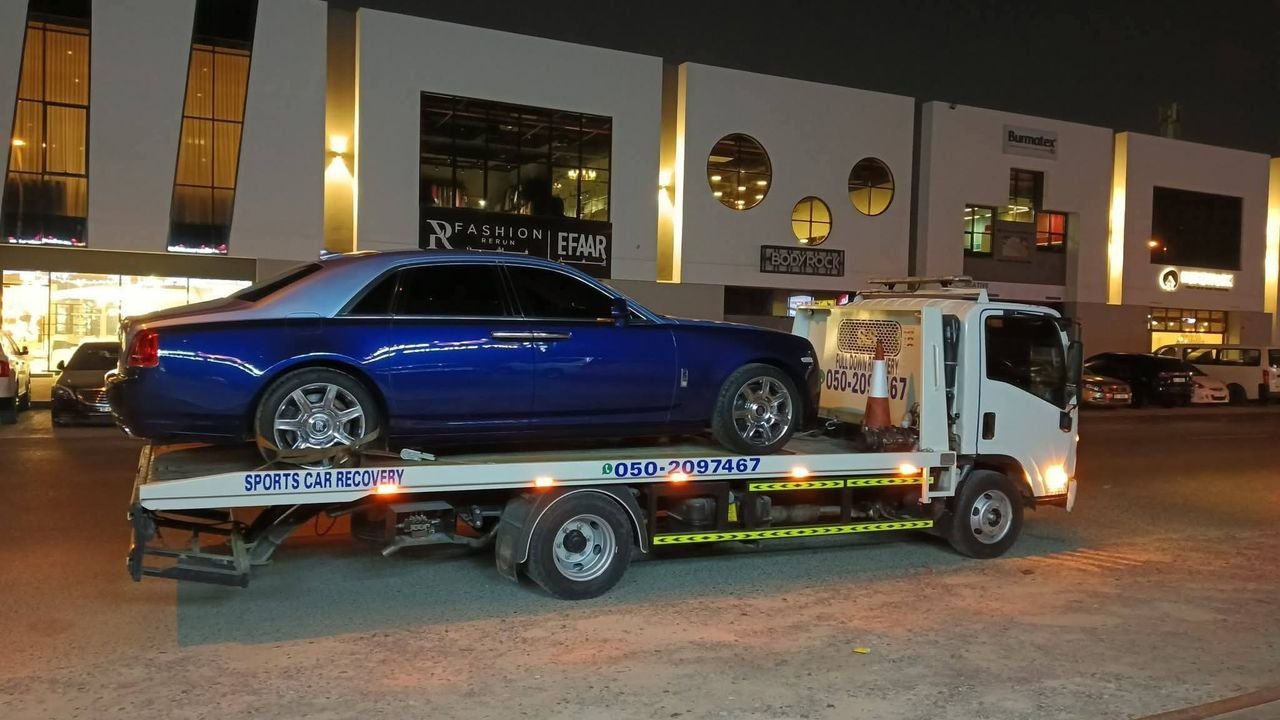
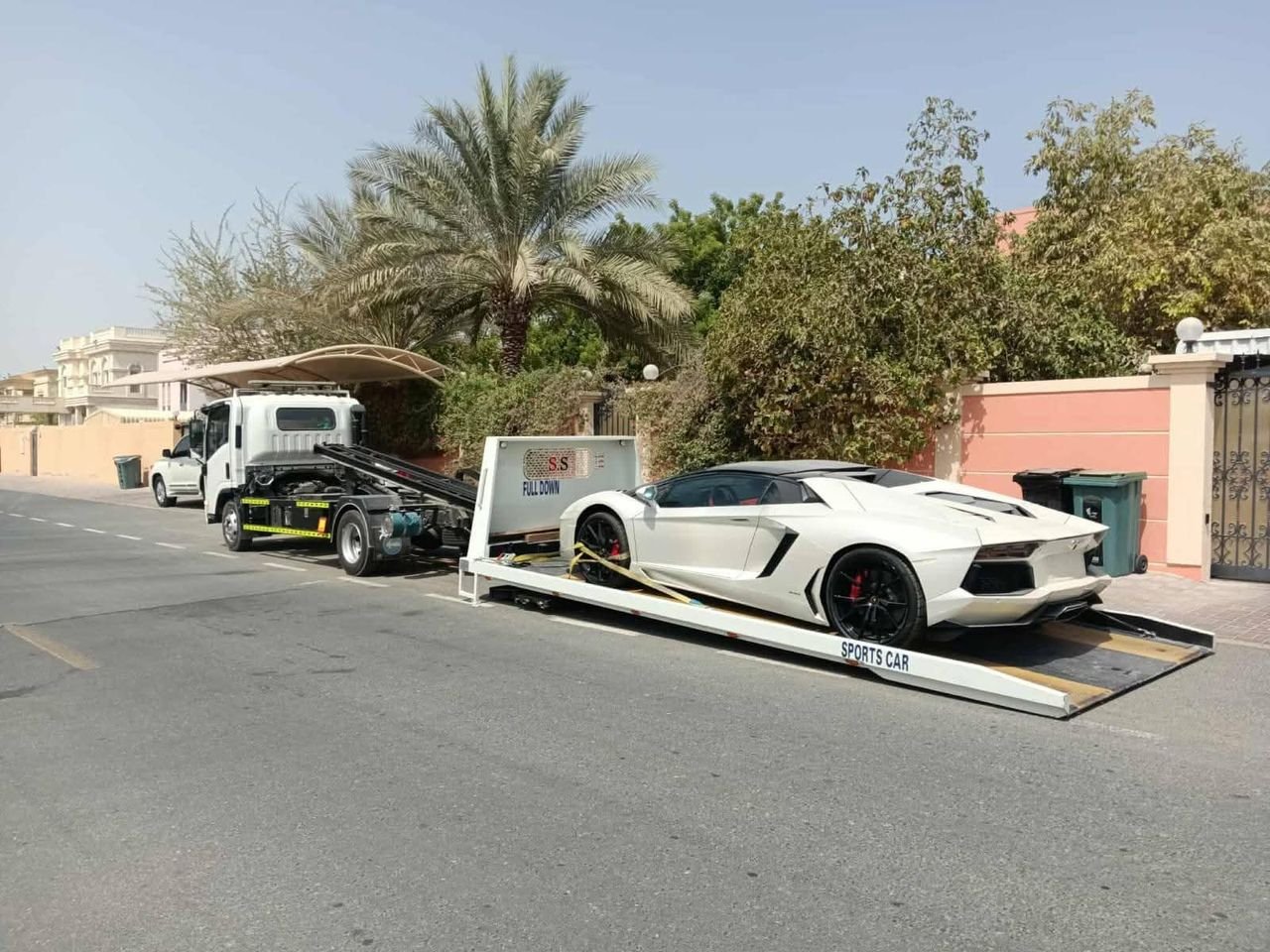
Flatbed Loading in Practice
Real photos from our daily recovery work in Dubai.
Frequently Asked Questions
What is the difference between flatbed and wheel-lift towing?
A flatbed carries your entire car on a level platform with all four wheels off the road. A wheel-lift raises only the front (or rear) wheels while the other two roll on the ground. Flatbed is safer for the drivetrain, suspension and bodywork; wheel-lift is quicker and cheaper but puts stress on the wheels left on the ground.
Which towing method is safest for luxury cars?
Flatbed, without question. Luxury and sports cars have low ground clearance, delicate bodywork and complex drivetrains that wheel-lift towing can damage. Flatbed transport with soft straps keeps all four wheels off the road and the car perfectly level. Our luxury car recovery service is flatbed-only for exactly this reason.
Can AWD and 4x4 vehicles be wheel-lift towed?
No — not safely. All-wheel-drive and 4x4 vehicles must be transported on a flatbed, because towing with any wheels on the ground can destroy the transfer case and differentials. This is critical in Dubai, where Land Cruisers, Patrols and performance AWD cars are everywhere. Always specify flatbed for AWD vehicles.
Is flatbed towing more expensive than wheel-lift?
Slightly, because flatbed trucks and the loading process cost more to operate — but the difference is small compared to the repair bill from a bad tow. For standard cars the price stays within the AED 150–250 range either way. For luxury cars (AED 150–250), flatbed is included as standard because it is the only safe method.
When is wheel-lift towing acceptable?
Wheel-lift is fine for short moves of standard front-wheel-drive or rear-wheel-drive cars with no drivetrain damage — for example, moving a car a short distance to a nearby workshop. Even then, a flatbed is gentler. We default to flatbed-first: we only wheel-lift when the situation genuinely suits it.